

Kaleido’s latest Vertical Connectivity report offers insight into the role cellular connectivity is playing in the modern manufacturing industry. The report examines several cellular technologies, their use cases and points of integration into the manufacturing value chain.
Cellular IoT has embedded itself as a key part of manufacturing, particularly in discrete manufacturing. The benefits of connectivity and automation are evident in many case studies across many sectors, particularly in large-scale manufacturing. This has encouraged the adoption of the technologies in many places, particularly for large manufacturers.
Solution-First, Not Connectivity-First
Note that this does not reflect the overall use of any connectivity in the IoT, but that of cellular; in many cases, the choice is not whether to connect devices, but which connectivity to adopt. Cellular must sit alongside other technologies, from Wi-Fi and LoRaWAN to wired ICS, if it is to serve the needs of manufacturers. This is particularly true even as AI and robotics use cases take centre stage in manufacturing; the key elements are the results and efficiencies brought by these technologies, not the technologies themselves. While greenfield deployments can potentially build from the ground up as a cellular-first or cellular-only system, these are very much in the minority.
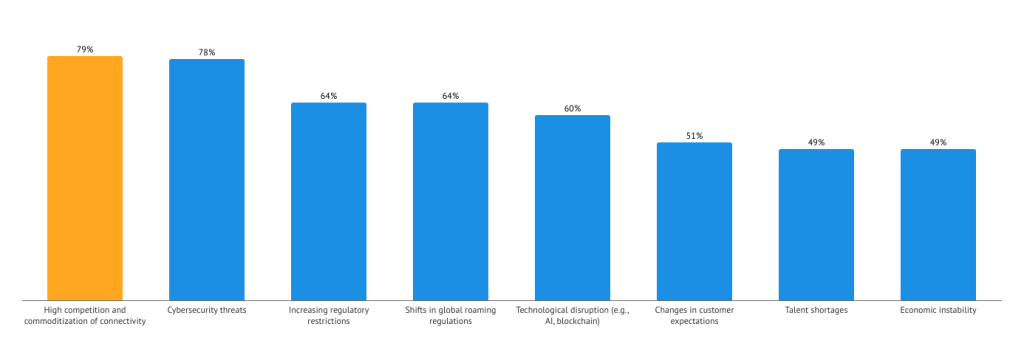
The end application of factory monitoring is the only real technology that the end user is concerned with, and the underlying connectivity for the platform-level solutions does not ultimately matter so long as it delivers reliable results. This has been shown in multiple Kaleido Intelligence surveys, particularly regarding private networks; that reliable network coverage is the closest the manufacturing industry gets to a killer app for connectivity, rather than high throughput, AR and other high-tech use cases. This is reflected in Kaleido Intelligence’s 2025 CSP survey, where CSPs serving manufacturing see connectivity commoditisation as a bigger threat than technological disruption.
CSP Business Threat Perception: What do you perceive as the biggest risks for your business in the next 2-5 years?
Technology Lifecycles Alignment
Part of the reason for a lack of concern about the technology is that manufacturers expect manufacturing equipment to last longer than traditional technology lifecycles, reaching decades of operation in many cases. This means that connectivity and control need to be provided for endpoints that are operating with far less capability than the current state of the art of digital technology in general, and essentially need to operate on their own refresh cycle.
Manufacturing Layers Lifecycles
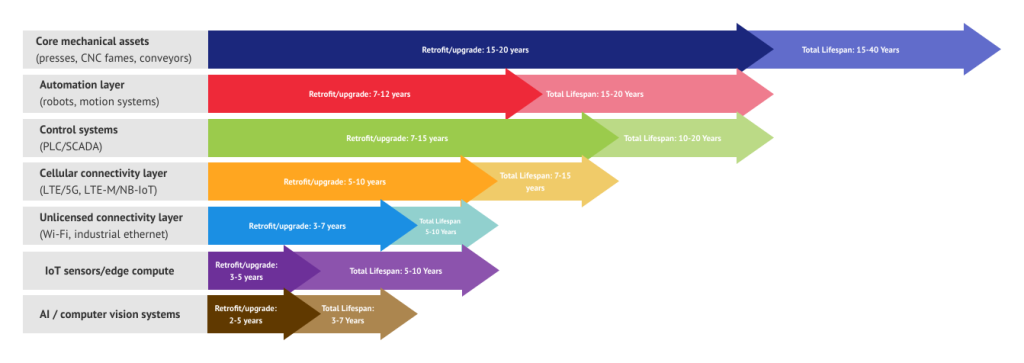
These long lifecycles mean that CSPs and other data-handling players need to work with many legacy protocols. This is standard for manufacturing software, which frequently advertises compatibility with many different OT protocols, often in the range of 150-300. This can involve a large amount of investment, particularly for those protocols which are intended to transfer raw data over a physical layer connection, but CSPs that provide gateways have an opportunity to control and standardise data flow for these, which can otherwise be provided by cloud vendors or industrial software providers.
This high level of legacy equipment translates into a lower expectation for OTA (over-the-air) updates, and indeed, only 28% of IIoT CSPs provide this, compared to 43% of providers for other verticals. However, this will become more important as the local control layers (with shorter refresh cycles) become more complex and integrated into AI-driven systems. This will bring longer-lasting change to the manufacturing environment, driven by an underlying digitisation, but this will be driven at the application level, not from the impact of connectivity on its own.
Connectivity in the Sales Channel
Manufacturing OEMs, covering those who build and sell equipment to end user manufacturers, are a necessary part of the process of connectivity integration, with most connected manufacturing devices already shipping with some predetermined level of connectivity capability. This matches patterns Kaleido observes from end users; only 9% want to add connectivity hardware as a purely after-market solution, with the rest wanting some degree of pre-installation. As such, OEMs need to at the very least be prepared to integrate cellular modules into their products. Partnering with OEMs as the primary customers for connectivity hardware and services is a strong business model in this space.
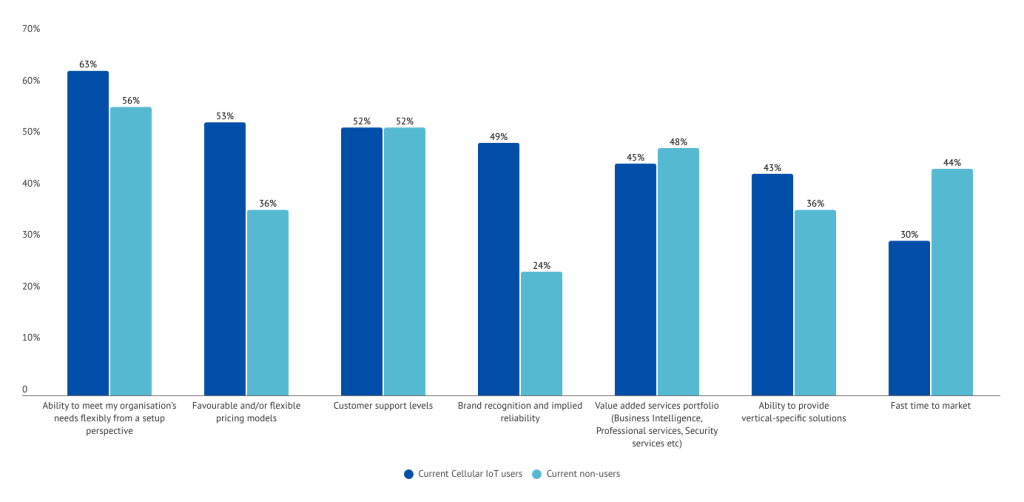
End users often choose MNOs for their IoT connectivity needs, giving MNOs a bigger opportunity to own or direct the whole technology stack, based on the end application. However, MNOs need to be ready to make highly custom deployments when called upon; Kaleido’s latest enterprise survey found that the most common non-technical factor in deciding which CSP to use was flexibility in meeting end-user requirements. This means the biggest winners will be those who already have dedicated integrator-like IoT support within their structures to support this kind of customisation, even if they are not MNOs themselves.
Non-technical CSP End User Requirements: What are/would be the main non-technical/commercial influences impacting your choice of potential IoT connectivity service provider?
 Access Kaleido’s Cellular Connectivity Series: Manufacturing Opportunities research for a full evaluation of industry expectations of cellular connectivity, and which elements of cellular technology can bring the best benefits to manufacturing use cases across the value chain.
Blog Author: James Moar (Principal Analyst)