

Last week, I was at Aeris for their annual Partner Summit event, which offers a dive under the hood of products and solutions, coupled with interesting discussions around how IoT is being disrupted, some of which focused on physical AI and what it means for the network (and reflected much of what we’ve discussed here). A couple of days later, Kaleido presented the initial findings of its latest enterprise and OEM IoT connectivity survey (n = 1,000) with experts from Giesecke+Devrient, Telenor Connexion and Orange.
The Partner Summit served to underline our longstanding position that CMPs (Connectivity Management Platforms) are not table-stakes solutions that only have commodity value. Over the years of deep diving into players’ solutions and roadmaps over the years it has been clear that there is significant scope for innovation. Our Vendor Hub analyses have always been forward-looking in terms of how we observe enterprise and OEM requirements developing, and this session, as well as other providers’ activities we’ve observed over this year provide a strong validation against our early observations of trends.
Observability Fuels Innovation
What was evident from the demos and roadmap run-throughs is that the very notion of connectivity management for large-scale fleets is currently being redefined and, as one well-regarded analyst darkly noted at the event, those who do not keep up with these shifts might eventually see themselves forced out of the market. Platforms are no longer static or constrained in terms of the menu options made available in the GUI but respond dynamically to user requirements and serve as tools to deliver highly complex data rationalisation and fleet analytics.
For Aeris, AI is at the heart of this shift, as it is for other players that are adopting their own unique approaches to connectivity management solution development. Nonetheless, underneath all of this is the data – consumption, signalling information, device contexts, business rules and so on – that feeds into the AI systems that are so effective at crunching the numbers and making sense of them. Getting hold of this data means that the CMP and its adjacent platforms, as well as the mobile network itself, can no longer be viewed as something within a vacuum. Observability in the context of data ingestion and timely presentation, as we have talked about over the last few years, is now a fundamental part of advanced connectivity management.
IoT Connectivity Survey: Breaking Fragmentation and Delivering Compliance from End-to-End
Our enterprise and OEM survey, which we collaborated on with Giesecke+Devrient, provides a confirmation of this direction of travel for IoT connectivity. As we can observe below, the market shows strong signals of maturation: TCO, end-to-end policy management and a need for compliant connectivity are key concerns today among many end users and OEMs. These are not easy challenges to solve, especially in a fragmented telco ecosystem. The effects of this fragmentation are quantifiable: for example, when applying regression analysis to respondents in the Energy & Utilities sector, the need to source connectivity from multiple MNOs increases respondents’ concerns over security by 15%. Why? Because applying a uniform policy across those providers is not easy. At the same time, regression testing reveals that, for respondents with heavy compliance requirements, the odds of sensitivity to the TCO of connected device programmes increase by 6 times.
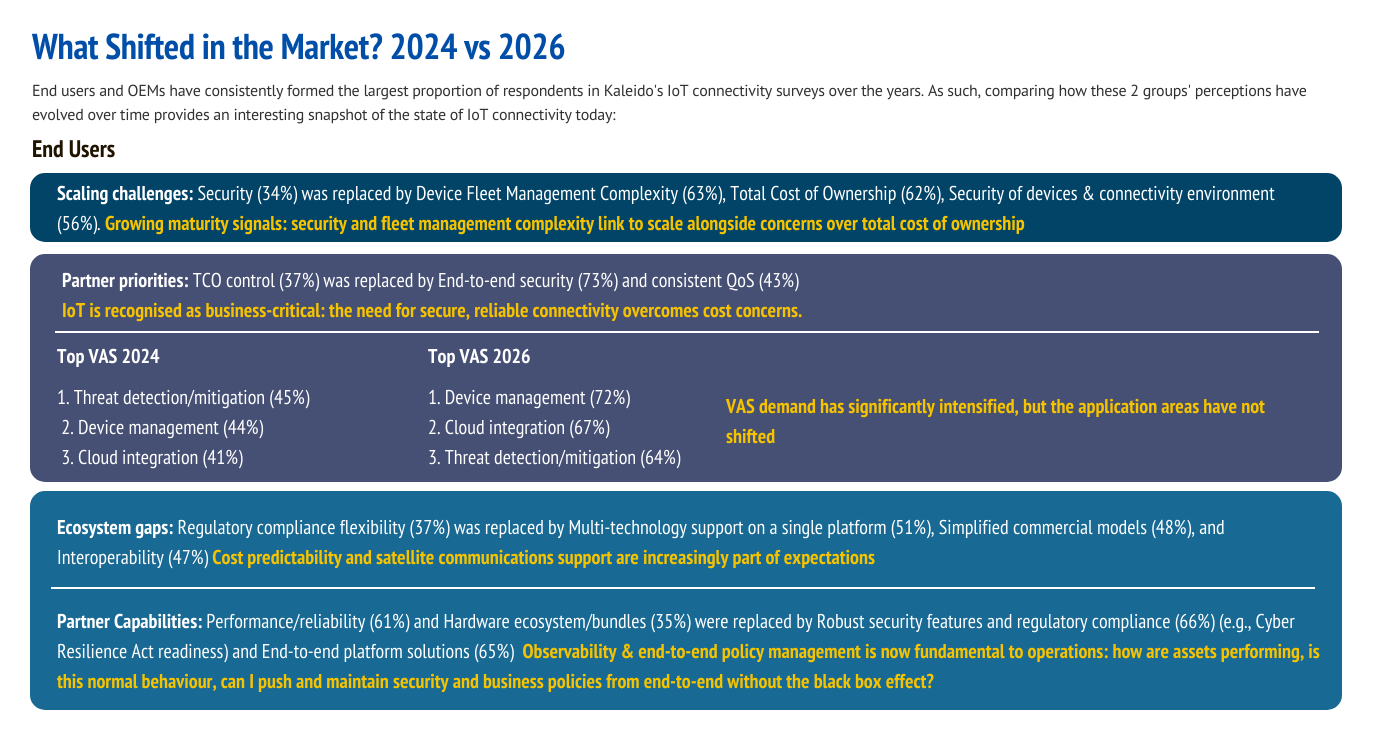
Source: Kaleido Intelligence
Emerging technologies and approaches are helping relieve these concerns, and the survey respondents provided indicators as to where pain points can be relieved. Within the Transport & Logistics sector for example, correlation analysis demonstrated that application of AI to support fleet and network optimisation, and application of network anomaly detection capabilities both served to alleviate concerns over TCO. Tellingly, both of these examples rely on strengths in observability.
Looking ahead, the adoption of SGP.32 provides both the anchor for future IoT connectivity as well as a technology that will only increase the pressure to support observability across diverse networks and platforms. Indications for adoption are so far encouraging: we saw SGP.32 platform pipelines already reaching ~33% of all M2M platform instances deployed (since 2016) by the end of 2025. Meanwhile, the survey data shows promising signs: over 90% of current eSIM users understand SGP.32 offers a more open, flexible ecosystem for choosing connectivity. As G+D’s Andreas Morawietz noted in our webinar – the question is no longer if SGP.32 will be adopted, but how quickly players across the value chain can turn its capabilities into measurable business value.
Blog Author: Steffen Sorrell (Chief of Research)