

Which Verticals are Best-Suited to Cellular-Satellite IoT?
Cellular-satellite connectivity has become highly topical in recent years, following the release of 3GPP Release 17 which began a steady process of convergence between the two technologies in 2022. This has continued with the introduction of D2D (direct-to-device) capabilities in subsequent releases, and the IPO of SpaceX, with the company’s Starlink division assuming that the entire telecoms sector is a potential TAM (total addressable market). This is against a backdrop of an increasing number of MNOs and some MVNOs offering cellular-satellite packages.
Kaleido’s latest research on Cellular-Satellite connectivity for IoT examines the implementation concerns for developing IoT use cases of cellular-satellite, where they interact with terrestrial cellular infrastructure, and what that means for the delivery of cellular-satellite services for IoT. This is highly dependent on the vertical in question, which must balance the competing issues of the cost of connectivity against the need for coverage and reliability.
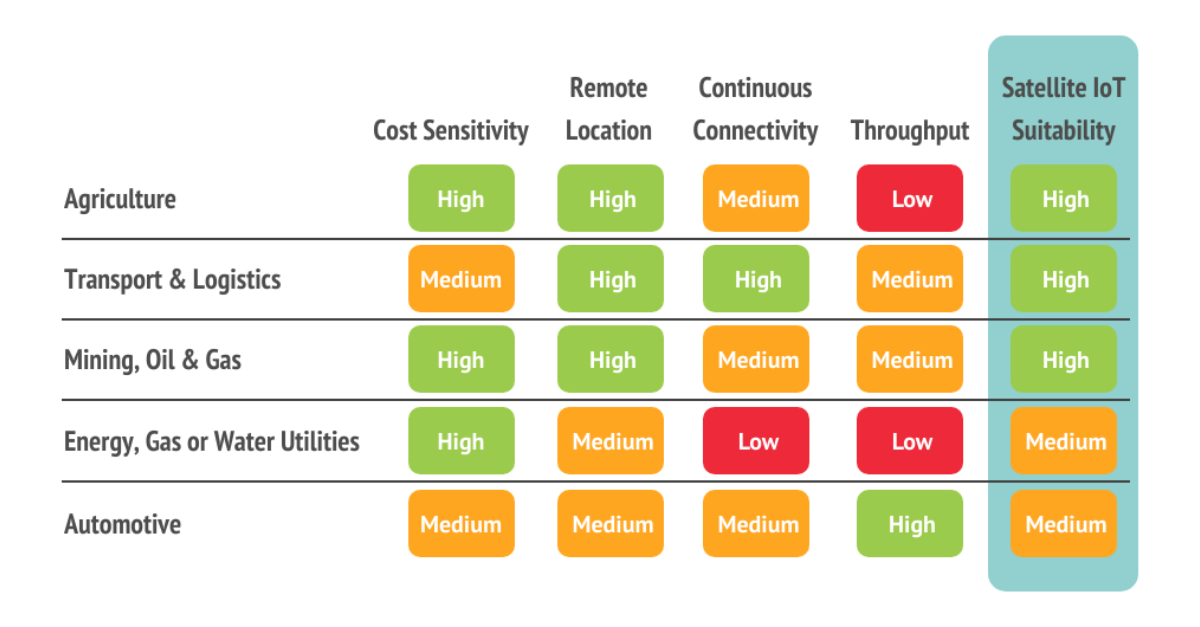
As part of this, we have created a Cellular-Satellite Suitability Matrix, to illustrate which verticals will find cellular-satellite connectivity most appropriate for their use cases. This matrix was assembled through a combination of evaluation of cellular-satellite specifications and technical capabilities, conversations from vendors in the space and feedback from Kaleido’s ongoing surveys of enterprises interested in cellular IoT. While TCO (total cost of ownership) is a key concern across the IoT, cellular-satellite is most suitable for verticals where this is balanced with unpredictable OPEX (operational expenditure). Where connectivity costs can be kept stable, and potentially leverage satellite as a means to avoid revenue loss, cellular-satellite IoT use cases will find their most fertile markets.
IoT Vertical Cellular-Satellite Suitability Matrix
Source: Kaleido Intelligence
Agriculture
Agriculture represents some of the best use cases for cellular-satellite, as cellular connectivity is often entirely absent. At the same time, the sector has a combination of low- and high-throughput use cases, which can keep costs as low as needed, while providing entirely new use cases with cellular standards reducing hardware costs sufficiently to be appealing to a relatively wide audience.
Agriculture use cases for satellite connectivity are mostly centred around data relay, from both stationary and mobile assets that are in rural and remote regions. IoT sensors tracking soil composition and animals going beyond terrestrial network reach are the most common. As with all use cases however, cellular-satellite is likely to run alongside other forms of connectivity, most typically terrestrial cellular.
Most current use cases require at most daily transmissions, or only condition-based detection (eg flooding or livestock illness). These require frequent small data delivery, and can be stationary or mobile. These are well-suited to NB-NTN use cases, and can be a cost-saving measure if the alternative is a private terrestrial network, either cellular or LoRaWAN, to cover an equivalent area. It is certainly the case that such an arrangement can save on network management.
Mining, Oil & Gas
Sending infrastructure monitoring data from remote installations, from mines and oil and gas facilities to offshore wind farms can be done via cellular technology. This may previously have been done via VSAT or other satellite mechanisms, but this requires signals to be collected through another terrestrial connectivity mechanism first; D2D allows for each device to relay directly, without the need for intermediate network nodes. This will typically be interval-based data (eg daily condition monitoring), but can also be condition-based as needed.
Oil and gas, as well as the broader energy and utilities sector (eg grid maintenance) can benefit from cellular-satellite-connected monitoring of workers, tracking the status of those working in the field, regardless of terrestrial connectivity. This kind of use case will require connectivity built into the device and overall safety platform, meaning that the device OEM is the main customer for the CSP, as the end user providing the field service will be most likely looking to buy the device with connectivity entirely built in.
Utilities & Metering
Smart metering is the biggest utilities connectivity market overall, and a minority of devices here can benefit from cellular-satellite connectivity as either a fallback mechanism or as primary connectivity for remote locations. This can reduce the bill of materials by reducing the need for multiple radios to act as fallback for a lack of cellular coverage. As a typically interior deployment, some devices will often need additional antennae at installation, but this cost can be relatively minimal when reckoned against a 10-15 year deployment lifespan and a reduction in hardware costs across a whole meter fleet.
The utilities sector overall has a large number of potential use cases, but these are often relatively small use cases relative to the overall connectivity used by the sector. As such, there are opportunities in several use cases, but no one will claim a particularly large number of connections.
Automotive
Automotive has been one of the strongest adopters of cellular IoT connectivity in general, and will continue to be so for NTN. The ability to have always-on connectivity will enhance SOS capabilities, allowing universal eCall capabilities and other SOS features. While this is currently restricted to messaging, NB-NTN voice solutions are being developed and will be deployed in the short term. However, the standards are imprecise enough that implementation of the capabilities based on the standards will rely on specific partnerships. For example, Viasat’s demonstration of voice over NB-NTN relies on Qualcomm’s Auto 5G modem and a Fraunhaufer-specific codec. This will make solutions available fairly rapidly, but will rely on a small number of suppliers in the short term. As such, the connectivity is often the only standards-based element in an otherwise relatively proprietary solution stack.
Having said that automotive is a successful segment, the majority of cellular-satellite use cases will need to be enterprise-focused; consumer subscriptions for additional automotive features have not gained much traction to date. By contrast, extending existing enterprise connectivity use cases into the satellite realm will be a small cost addition rather than a whole new subscription. That cost increase alone may make some providers reticent to use it, but there is more chance in the commercial sector.
One of the biggest consumer opportunities is as a potential long -term solution for emergency communications than existing eCall solutions. Many of the earliest eCall implementations in Europe are based on CS (circuit-switched) technologies, which will become obsolete as these networks are sunset over the late 2020s and early 2030s. While there are few indications that LTE-based technology will suffer a similar fate, automakers may naturally have concerns that their products will once again outlast the cellular infrastructure they rely on. With cellular LPWAN technologies grandfathered into 5G standards and now extended to NTN, NB-NTN may be seen as the best option for a long-term solution, particularly as NTN networks are often behind terrestrial networks in deploying the latest 3GPP releases. However, the lifespan of satellites also means that any deactivation of technologies will potentially happen sooner, and so we expect many of these use cases to depend on NB-NTN, which has been indicated to persist in 5G despite not being a core technology feature, and so can be maintained more readily than non-LPWAN technologies.
Access the report
Access Kaleido’s latest Cellular-Satellite IoT Connectivity: Use Cases & Opportunities 2026 to explore cellular-satellite IoT opportunities across agriculture, mining, utilities, automotive and more, with analysis of use cases and business models.
Blog Author: James Moar (Principal Analyst)